
RFT #2 • PERMANENT RECORD
Exodus
Loire Valley, France • 2014 • Original Kodak High Speed Infrared Negative
The photographic master that became the second Real Fungible Token.
THE PHYSICAL MASTER
The Photograph Begins Here
Exodus
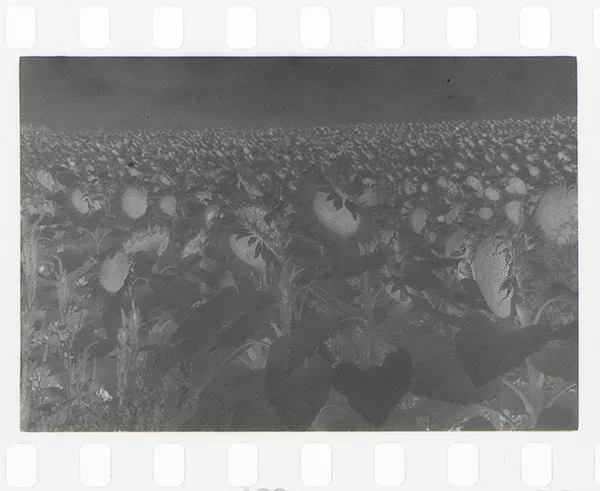
Original Kodak High Speed Infrared (HIE) 35mm Negative • Frame 28
Original negative identified • Documented • Archived
THE PHOTOGRAPH
Exodus
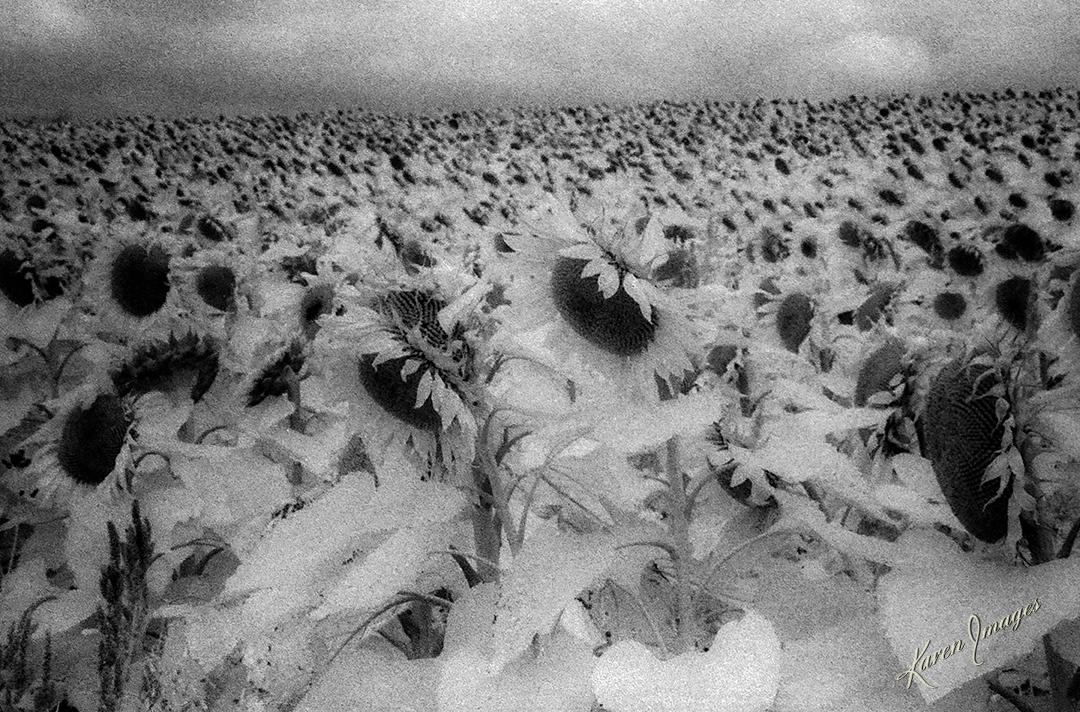
The finished photograph originates from the physical negative documented above. Prints, scans, publications, and other authorized uses may carry the image into different forms, but the original Kodak High Speed Infrared negative remains the singular photographic master at the center of RFT #2.
THE ORIGIN OF THE PHOTOGRAPH
Getting Lost in the Loire Valley
In 2014, we returned to France for our eighteenth anniversary, celebrating the completion of the Club E commission.
During the final days of the trip, we did something we have often done with cameras in hand. We deliberately got lost.
Wandering through the Loire Valley looking for scenes to photograph, we came upon a field of mature sunflowers.
We photographed the field in several formats, but the image we most wanted to make was composed for Kodak High Speed Infrared film.
THE FILM ITSELF HAD A HISTORY
In 2007, as the disruption of digital photography was transforming the photographic industry and Kodak was dismantling portions of its historic manufacturing complex in Rochester, the company announced that Kodak High Speed Infrared film would be discontinued.
We knew that once the remaining film was gone, this particular photographic material could not simply be replaced.
We purchased 100 rolls of HIE from B&H and placed them in frozen storage.
Seven years later, one of those rolls traveled with us to the Loire Valley.
Standing before the sunflowers, we composed the photograph specifically for infrared without knowing whether film that had spent years in our freezer would still produce the image we hoped to see.
We made the exposure anyway.
One of those exposures would eventually become Exodus.
THE SCAR IN THE NEGATIVE
Something Happened in Processing
When we returned from France, four exposed rolls from the trip were taken to David E. Russell's home in Acworth for processing. The final roll came back carrying something we had never intended to put there.
01. THE PROCESSING
Apparently, while the final roll was being loaded onto the processing reel, a portion of the film folded back onto itself.
The resulting sprocket-track scar runs along approximately the bottom eighth of the negative strip across frames 25 through 29.
The sunflower composition was exposure-bracketed. Frame 28 produced the best exposure and was selected as the photograph that became Exodus.
The scar is difficult to see with the naked eye, but becomes visible under close examination of the negative.
02. THE MASTER
Because of the processing artifact, the roll was never conventionally printed. A single contact sheet was made, and the negative returned to the Karen Images archive.
Years later, Exodus was digitally scanned and the processing artifact painstakingly removed from the finished image.
The original negative remains unchanged. The scar is permanently embedded in Frame 28 and has become part of the physical history of the photographic master.
A finished image can be perfected. The master will always carry what happened to it.
PROVENANCE & HISTORY
The Record of RFT #2
The provenance of RFT #2 begins with the photographic material, the creation of the image in France, and the preservation of its original negative in the Karen Images archive.
01. THE FILM
Kodak High Speed Infrared (HIE) 35mm film from the cache acquired by Karen Images following Kodak's 2007 discontinuation of the material.
02. CREATION
Loire Valley, France • 2014
The infrared composition was exposure-bracketed on Kodak HIE. Frame 28 produced the selected exposure and became Exodus.
That original 35mm negative is the physical photographic master of RFT #2.
03. PROCESSING & ARCHIVE
After returning from France, the exposed film was taken to David E. Russell's home in Acworth, Georgia, for processing. Russell Image Processing, Inc., the custom photographic lab he had operated in Atlanta for 25 years, had closed its doors in 2011.
For Karen Images, Russell had long been the trusted specialist for black-and-white film. Even after the lab closed, important film continued to be entrusted directly to him for processing.
A processing artifact affected frames 25 through 29, including Frame 28. One contact sheet of the roll was made, but the negative was never conventionally printed.
The processed film was returned to the Karen Images archive, where Frame 28 has remained preserved as the physical master of Exodus.
04. THE ARCHIVE
The roll that produced Exodus was part of the original cache of 100 rolls of Kodak High Speed Infrared film acquired by Karen Images after Kodak announced the film's discontinuation.
Approximately 80 rolls from that cache remain frozen in lead bags in the Karen Images archive, preserved for photographs yet to be created.
Frame 28 is different. It has already been exposed, processed, selected, and preserved. What began as one roll from a finite supply of photographic material became the singular physical master of Exodus.
FEBRUARY 2022
The Photograph Found Its Purpose
Eight years after Exodus was created, Russia's full-scale invasion of Ukraine began.
Within days, people were fleeing their homes in extraordinary numbers.
At almost the same moment, our discussions to use RFT #1 to benefit the restoration of Notre-Dame were coming to an end.
We could not justify continuing to devote our effort to raising money for a cathedral spire while people were being displaced by war.
As the refugee crisis unfolded, images of sunflowers and the Ukrainian flag began appearing across social media.
Then something unexpected happened.
Troy woke from a dream remembering a photograph we had created eight years earlier in France.
Exodus.
Thousands of sunflowers stretching across a field in the Loire Valley.
We had not created the photograph with Ukraine in mind. It had been made in 2014, years before the events that now gave us reason to see it differently.
But suddenly the photograph we had never printed seemed impossible to forget.
THE CONNECTION
The Master Carried Its History
The connection was immediate.
The sunflower had become a visible symbol of Ukraine as the world watched people being displaced by the war.
And the photograph carried something else.
The negative itself had been scarred during processing eight years earlier. The scar could be removed from the finished digital image, but it could never be removed from the physical master.
A finished image can be perfected.
The master will always carry what happened to it.
The meaning had not been there when Exodus was created.
It was there now.
RFT #2
Exodus
We made a decision.
Exodus would become RFT #2.
The original Kodak HIE negative, Frame 28, became the physical photographic master at the center of the second Real Fungible Token.
For the first time since it was created in France eight years earlier, Exodus had a purpose beyond the photograph itself.
MARCH 7, 2022
RFT #2 Entered the Public Record
On March 7, 2022, Karen Images publicly introduced Exodus as RFT #2 through SetArtATL.
The announcement publicly connected the photograph, its physical master, and the humanitarian purpose behind RFT #2.
The photograph that had remained unprinted since its creation in France was now connected to a specific physical negative, a documented purpose, and a proposed transfer to a future collector.
RFT #2 had entered the public record.
01. ORIGINAL MASTER
Original Kodak High Speed Infrared (HIE) 35mm Negative • Frame 28
02. ORIGINAL PURPOSE
RFT #2 was created with the intention that its transfer would generate meaningful financial support for organizations assisting people displaced by the war in Ukraine.
THE ORIGINAL PROPOSAL
The Idea Was Still Taking Shape
When RFT #2 was introduced in March 2022, the Real Fungible Token was still a new idea.
The original proposal contemplated transferring Negative 28 together with a 30 × 20 presentation of Exodus and defined reproduction rights to a collector, with the charitable purpose established from the beginning.
The underlying principle was already there: a singular physical photographic master could carry ownership, productive rights, provenance, and purpose forward to its collector.
Over the following years, the structure surrounding that principle became more precisely defined.
RFT #2 retains its original history and purpose while its future transfer is governed by the RFT Standard as it exists at the time of transfer.
THE PRESENT RECORD
RFT #2 Still Waits
More than a decade after Exodus was created, its original Kodak HIE negative remains in the Karen Images archive.
RFT #2 has never been transferred to a collector.
Its physical master, documented history, and original humanitarian purpose remain intact.
The purpose established in 2022 has never been fulfilled because RFT #2 has never been transferred.
It still waits for its first collector.
THE TRANSFER
The Master. The Print. The Rights. The Record.
The transfer of RFT #2 is more than the sale of a photographic negative.
The collector receives the original physical master, Frame 28 of the original Kodak High Speed Infrared 35mm negative, a curated print produced by or under the supervision of Karen Images, and the economic rights defined by the RFT transfer agreement.
Exodus has never been produced as an individual photographic print. Since its creation in 2014, the image has existed physically only as the original negative and on a photographic contact sheet. The curated print accompanying the transfer will therefore become the first individual print produced from the image.
Those rights include the exclusive right to receive revenue from future authorized reproduction and licensing of the photograph.
Karen Images remains the recognized creator of the work and may continue to display the photograph as part of its portfolio, history, and documentation of the RFT Archive.
After transfer, Karen Images does not participate in reproduction or licensing revenue except as specifically provided by the transfer agreement.
The RFT also carries a continuing resale structure. On qualifying future transfers, a contractual royalty is paid to Karen Images or its assigns by the new collector for the duration provided by the agreement.
The negative is the master.
The curated print begins its physical exhibition history.
The provenance continues.
CURRENT RECORD
RFT #2 • Exodus
PHOTOGRAPHIC MASTER
Original Kodak High Speed Infrared (HIE) 35mm Negative • Frame 28
CREATED
Loire Valley, France • 2014
PHYSICAL CHARACTERISTIC
Permanent sprocket-track processing scar • Frame 28 • Continuing across Frames 25–29
CURRENT CUSTODY
Karen Images
TRANSFER HISTORY
No collector transfer recorded
ORIGINAL RFT PURPOSE
Established in 2022 to benefit organizations assisting people displaced by the war in Ukraine
The original photographic master, its processing scar, its documented history, and the purpose that led to RFT #2 remain preserved as part of its permanent record.
© 2026 Real Fungible Token. Built by Karen Images