
RFT #5 • PERMANENT RECORD
Christ Church
St. Simons Island, Georgia • July 1997
THE PHOTOGRAPH
A Historic Church in a Different Light
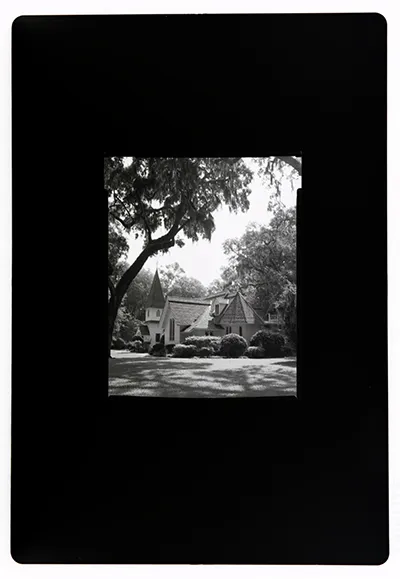
Digitally inverted view of the original 4 × 5 Kodak HIE negative.
Christ Church • St. Simons Island, Georgia • July 1997
THE PHYSICAL MASTER
The Original 4 × 5 Kodak HIE Negative
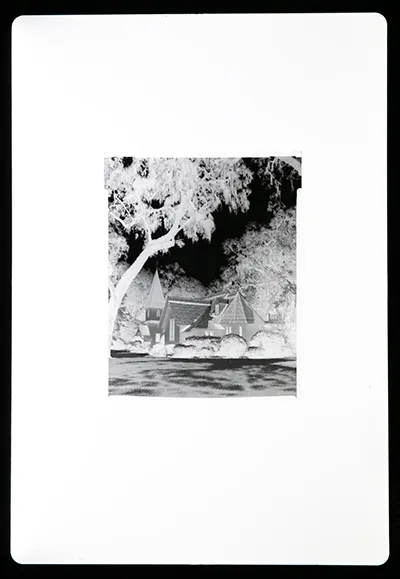
Original 4 × 5 Kodak High Speed Infrared (HIE) Camera Negative • July 1997
RFT #5 • Christ Church • St. Simons Island, Georgia
THE CAMERA
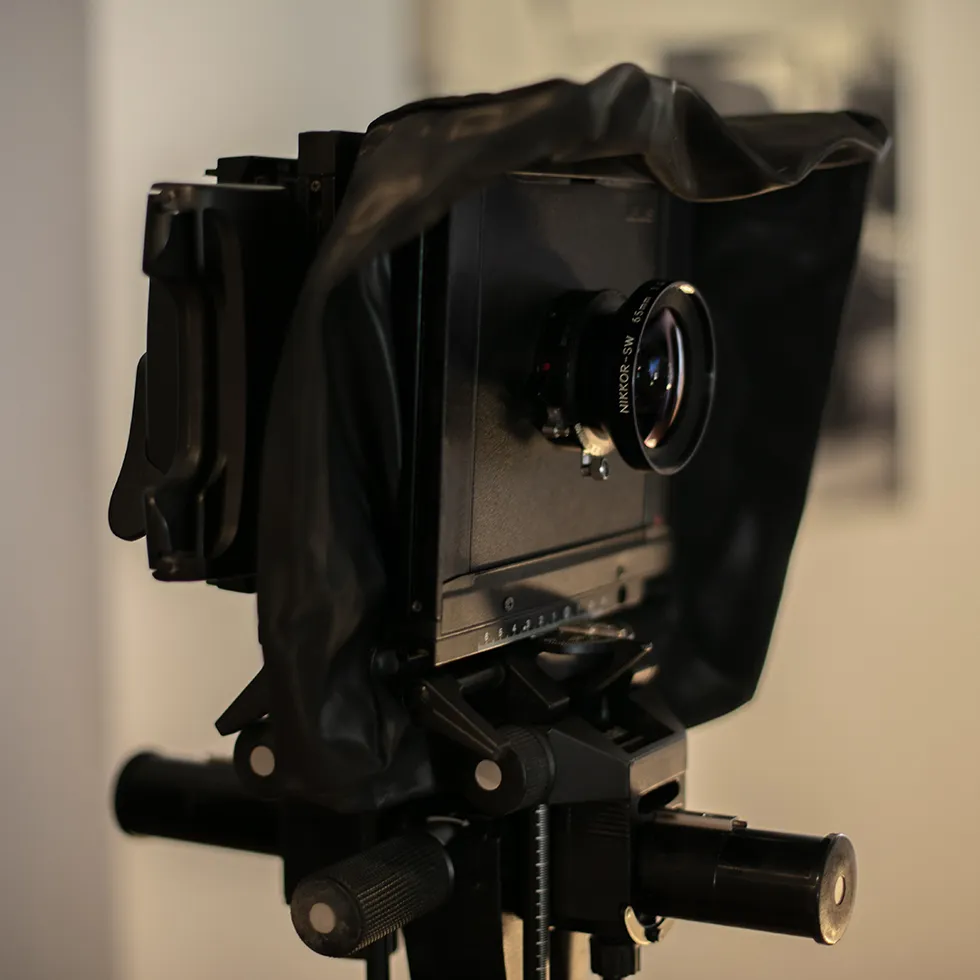
Sinar F1 + Nikkor-SW 65mm
The camera and lens used to create RFT #5.
LARGE FORMAT PHOTOGRAPHY
One Sheet. One Exposure at a Time
A 4 × 5 view camera does not use a roll of film.
Each photograph is made on an individual sheet of film measuring approximately four by five inches. The film is loaded in complete darkness into a double-sided holder. One sheet is loaded on each side, and each sheet is protected by its own dark slide.
To make a photograph, the image is first composed and focused on the camera's ground glass using a 10x loupe. The scene is manually metered for the ISO of the film and the f-stop you set on the lens. The film holder is then inserted beneath the ground glass. The dark slide is removed, exposing one sheet of film to the camera. The shutter is activated, the dark slide is replaced, and that single sheet has been exposed.
Turn the holder over and there is one more sheet available.
Then the film in the holder is removed from the holder and processed.
A 35mm camera could carry a roll of 36 exposures. Our five 4 × 5 holders carried only ten sheets of Kodak HIE.
Every exposure required a loaded holder, a deliberate composition, critical focus, an exposure calculation, and a decision that the photograph was worth one of the sheets we had brought with us.
And that only describes ordinary 4 × 5 film.
Kodak High Speed Infrared added another layer to the process. After composing the image and establishing critical focus on the ground glass, focus had to be compensated for infrared light. The lens was shifted from the visible-light focus position to its infrared focus index before the photograph was exposed.
Then came the infrared filter, the exposure calculation, and the particular handling requirements of Kodak HIE.
Making RFT #5 required all of it.
MAKING THE PHOTOGRAPH
Five Sheets of Kodak HIE.
After completing the first exposures of Christ Church, we decided the scene also needed to be photographed vertically.
The Kodak HIE already loaded in our film holders had been exposed, so we stopped. In a changing bag, the exposed sheets were removed and five more sheets of HIE were loaded into the holders.
We returned to the Sinar F1 and composed the vertical view of Christ Church with the Nikkor-SW 65mm lens.
The image was critically focused on the ground glass and the exposure was determined with a Gossen light meter and spot attachment. Kodak HIE was rated at ISO 25. Focus was compensated using the lens's infrared focus index, and a Wratten 89B infrared filter was attached to the lens.
Five individual sheets of Kodak HIE were exposed, beginning with the calculated base exposure and bracketing above and below it in half-stop increments.
Those five sheets were later processed by Showcase Photographics in Atlanta.
From those exposures, Karen selected this negative as the one she wanted to print and separated it from the others, marking the archival sleeve to avoid confusion during printing.
That selected negative is RFT #5.
THE SESSION
Three Compositions. About Two Hours.
We made only three compositions at Christ Church that day.
The Memorial Garden came first. After completing those five exposures, we moved to the front of the church and composed a horizontal view of Christ Church nestled among the live oaks.
We exposed the five sheets of Kodak HIE that remained loaded in our film holders.
Looking at the composition, we decided the same scene also needed to be photographed vertically. We had no loaded HIE left, so we stopped, unloaded the exposed film in a changing bag, loaded five more sheets of HIE into the holders, and returned to the camera.
Five more exposures were made of the vertical composition.
Fifteen sheets of Kodak HIE. Three compositions. About two hours.
WHY THIS RFT EXISTS
Made on a Film That No Longer Exists.
Kodak High Speed Infrared was unlike conventional black-and-white film. Its extended infrared sensitivity produced a distinctive rendering of foliage, skies and light that became closely associated with infrared photography.
Kodak produced HIE in 35mm and, for a time, as large-format sheet film, including 4 × 5. Production of the sheet-film formats ended years before Kodak discontinued HIE entirely.
RFT #5 was made on 4 × 5 Kodak HIE in July 1997, while the material was still commercially available. The original sheet selected by Karen for printing survives in the Karen Images archive.
The negative also belongs to the photographic history of its creators. Karen and Troy Burns worked together with large-format cameras, infrared materials, hand-held metering, view-camera movements and the deliberate process required to expose individual sheets of film.
The camera survives. The lens survives. The selected negative survives.
The film that made it possible does not.
THE REAL FUNGIBLE TOKEN
This Negative Is the Master.
RFT #5 is the original 4 × 5 Kodak High Speed Infrared negative selected by Karen for printing from the vertical exposures of Christ Church made in July 1997.
The photograph may be reproduced in other forms. The physical master cannot.
There is only one.
THE TRANSFER
The Master. The Print. The Rights. The Record.
The transfer of RFT #5 is more than the sale of a photographic negative.
The collector receives the original physical master, the original 4 × 5 Kodak High Speed Infrared negative of Christ Church, a curated print produced by or under the supervision of Karen Images, and the economic rights defined by the RFT transfer agreement.
The curated print is produced from the image represented by the physical master and becomes part of the documented record accompanying RFT #5.
Those rights include the exclusive right to receive revenue from future authorized reproduction and licensing of the photograph.
Karen Images remains the recognized creator of the work and may continue to display the photograph as part of its portfolio, history, exhibitions, and documentation of the RFT Archive.
After transfer, Karen Images does not participate in reproduction or licensing revenue except as specifically provided by the transfer agreement.
The RFT also carries a continuing resale structure.
On qualifying future transfers, a contractual royalty is paid to Karen Images or its assigns by the new collector for the duration provided by the agreement.
The negative is the master.
The curated print accompanies its transfer.
The provenance continues.
CURRENT RECORD
RFT #5 • Christ Church
Original Physical Master
4 × 5 Kodak High Speed Infrared (HIE) Camera Negative
Christ Church
St. Simons Island, Georgia
July 1997
Sinar F1 • Nikkor-SW 65mm
Karen Images
Selected by Karen for printing following processing by Showcase Photographics.
Physical master identified and documented as RFT #5 in September 2026.
Present Status
Original negative documented • Archived • In the custody of Karen Images
© 2026 Real Fungible Token. Built by Karen Images